Predictive Index Cognitive Assessment Practice Test Free Questions
Updated: July 2026 | Used by 10,000+ Learners Globally
The Predictive Index Cognitive Assessment (PICA) is a widely used pre-employment test designed to measure a candidate’s cognitive ability and capacity for problem solving.
Employers use the assessment to evaluate how quickly candidates can learn new information, identify patterns, and solve unfamiliar problems. The test is commonly used for roles that require analytical thinking, decision-making, and the ability to process information under time pressure.
Preparing for the Predictive Index cognitive assessment can significantly improve your performance. One of the most effective preparation methods is practicing with sample questions that mirror the style and difficulty of the real exam.
This Predictive Index Cognitive Assessment practice test provides sample questions that simulate the reasoning challenges found in the real assessment.
Practicing these questions can help you:
- become familiar with the test format
- improve your speed and accuracy
- build confidence before taking the real test
What Is the Predictive Index Cognitive Assessment?
The Predictive Index Cognitive Assessment, sometimes referred to as the PI Cognitive Test or PLI assessment, measures a candidate’s ability to learn, adapt, and solve problems quickly.
Unlike traditional knowledge-based tests, the PI cognitive assessment focuses on reasoning ability rather than prior knowledge.
The test evaluates three key cognitive areas:
- Numerical reasoning – solving mathematical problems quickly
- Verbal reasoning – interpreting written information
- Abstract reasoning – identifying patterns and logical relationships
Because the test is extremely time-pressured, employers use it to identify candidates who can process information efficiently and perform well under pressure.
Predictive Index Cognitive Assessment Test Format
Understanding the format of the Predictive Index cognitive assessment is essential for effective preparation.
Typical structure of the test:
- 50 questions
- 12-minute time limit
- mixture of numerical, verbal, and abstract reasoning questions
Candidates must answer questions quickly, often with only 15–20 seconds per question.
Because of this time pressure, practicing timed questions is critical for success.
Predictive Index Cognitive Assessment Practice Questions
Below are 16 Predictive Index cognitive assessment practice questions designed to reflect the style and difficulty of the real PI test.
These questions will help you familiarize yourself with the types of problems that commonly appear in the assessment.
For additional practice questions and answers tailored to the PI Cognitive Assessment, we recommend exploring our-
6 Predictive Index Cognitive Assessment (PLI) Practice Tests
If you wish to practice this test with a timer, check out this Youtube video that features the same questions with an 18-second timer for each one
1.If the assumptions are true, is the conclusion:
Assumptions:
All X devices are electronic.
Some Y devices are the same type as X devices.
Electronic devices cannot be recycled.
Conclusion:
Some Y devices cannot be recycled.
A) Correct
B) Incorrect
C) Cannot be determined based on the information available
Explaination
A) Correct
All X → electronic; some Y are X ⇒ some Y are electronic. If electronic ⇒ not recyclable, then some Y ⇒ not recyclable.
2.Which number has the lowest value?
A) 1/4 – 1/10
B) 3/5 – 1/9
C) 1/8
D) 1/2 – 1/20
Explaination
A) 1/8
Compute: 1/8 = 0.125;
1/4–1/10 = 0.25–0.1 = 0.15;
3/5–1/9 ≈ 0.6–0.111… ≈ 0.4889;
1/2–1/20 = 0.5–0.05 = 0.45.
The lowest is 0.125.
3.Ink is to pen as milk is to:
A) cow
B) carton
C) glass
D) liquid
Explaination
C) glass
Ink:pen (content:container) :: milk:glass (content:container). Garden/roses/petals don’t preserve the same relation.
4.Which of the following is the opposite of the word scarce?
A. limited
B. abundant
C. symbolic
D. partial
Explaination
B) abundant
Opposite of scarce is abundant. Others aren’t antonyms.
5.What is the next number in the sequence below?
5 13 29 61
A. 89
B. 97
C. 121
D. 125
Explaination
D) 125
Sequence 5, 13, 29, 61 with differences ×2: +8, +16, +32, next +64 → 61+64 = 125.
Before you continue
Notice these are untimed?
The real PI Cognitive Assessment is 50 questions in 12 minutes — about 14 seconds each, with no going back. If a few of these felt tight at your own pace, test day moves faster. Full-length timed simulations are the only way to rebuild that speed before it counts.
- 6 timed full-length mock exams (real 12-minute format)
- 300 questions with step-by-step worked solutions
- Time-management techniques for scoring under pressure
6.If the assumptions are true, is the conclusion:
Assumptions:
Employee A and Employee B both attend sessions P and R.
Session Q is never attended by employees who attend session R.
Conclusion:
Session Q is never attended by Employee A and B.
A) Correct
B) Incorrect
C) Cannot be determined based on the information available
Explaination
A) Correct
Anyone attending R never attends Q. A and B attend R ⇒ A and B do not attend Q.
7.What is the next number in the sequence below? 2 6 11 17 24
A. 29
B. 31
C. 32
D. 33
Explaination
C) 32
Differences increase by 1: +4, +5, +6, +7; next +8 ⇒ 24+8 = 32.
8.You have invited 120 people to a workshop. Of those people, 15 from the East cannot attend, 9 from the West cannot attend, 6 from the South cannot attend, and 10 from the North cannot attend. How many people should you expect to attend the workshop?
A. 100
B. 92
C. 86
D. 80
Explaination
D) 80
Total no-shows = 15+9+6+10 = 40. Expected attendees = 120–40 = 80.
9.Which of the following numbers has the lowest value?
A. 0.55
B. 4/7
C. 1/5
D. 0.42
Explaination
C) 1/5
Compare: 0.55; 4/7 ≈ 0.5714; 1/5 = 0.2; 0.42. Lowest is 0.2.
10.Which of the following is the opposite of the word certain?
A. doubtful
B. definite
C. usual
D. precise
Explaination
A) doubtful
Opposite of certain is doubtful. (Definite/precise are near-synonyms; usual is unrelated.)
11.Thirsty is to drink as cold is to:
A. freeze
B. blanket
C. warm
D. hot
Explaination
C) warm
“Thirsty → drink” (need → remedy/action). “Cold → warm (up)” mirrors the remedy relation better than “freeze/blanket/hot.”
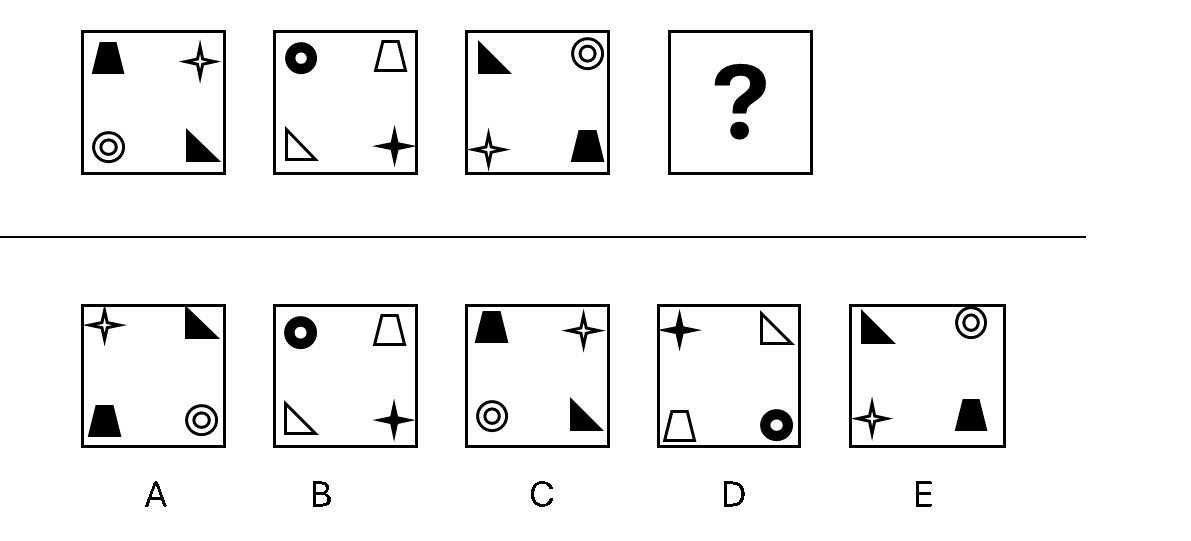
12.Which of the following boxes should be the next to complete the pattern?
Explaination
Correct Answer is D
Rule 1: Elements moves in anticlockwise direction
Rule 2: Elements at top left and bottom right are black and the other two are white
Following both the rules the next figure in the series will be Option D
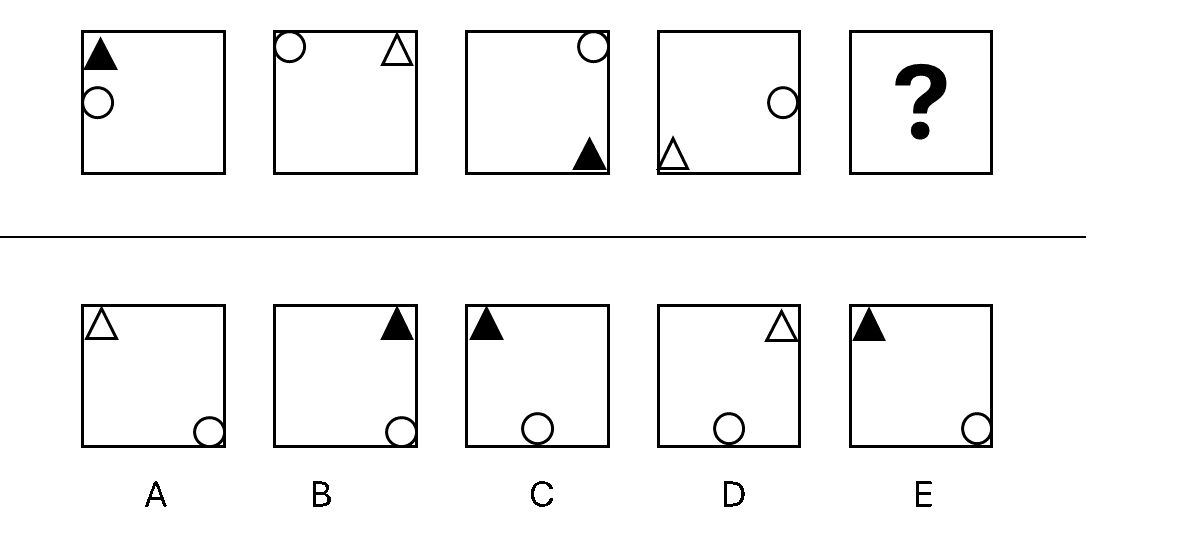
13.Which of the following boxes should be the next to complete the pattern?
Explaination
Correct Answer is E
There are two elements inside of a square in each figure of the sequence.
Rule 1: Triangle moves in corners in clockwise direction of the square in every iteration.
It starts from Top Left > Top Right > Bottom Right > Bottom Left.
So next position will be again back to Top Left
Rule 2: Triangle changes colour in alternate positions from black to white.
So next figure will have black triangle, since the last figure had white triangle
Rule 3: Circle moves in anticlockwise direction as well but it covers midpoint of every side of square along with the corners.
So next figure will circle in bottom right, basis its last position.
So next figure in the sequence which follows all three rules is Option E.
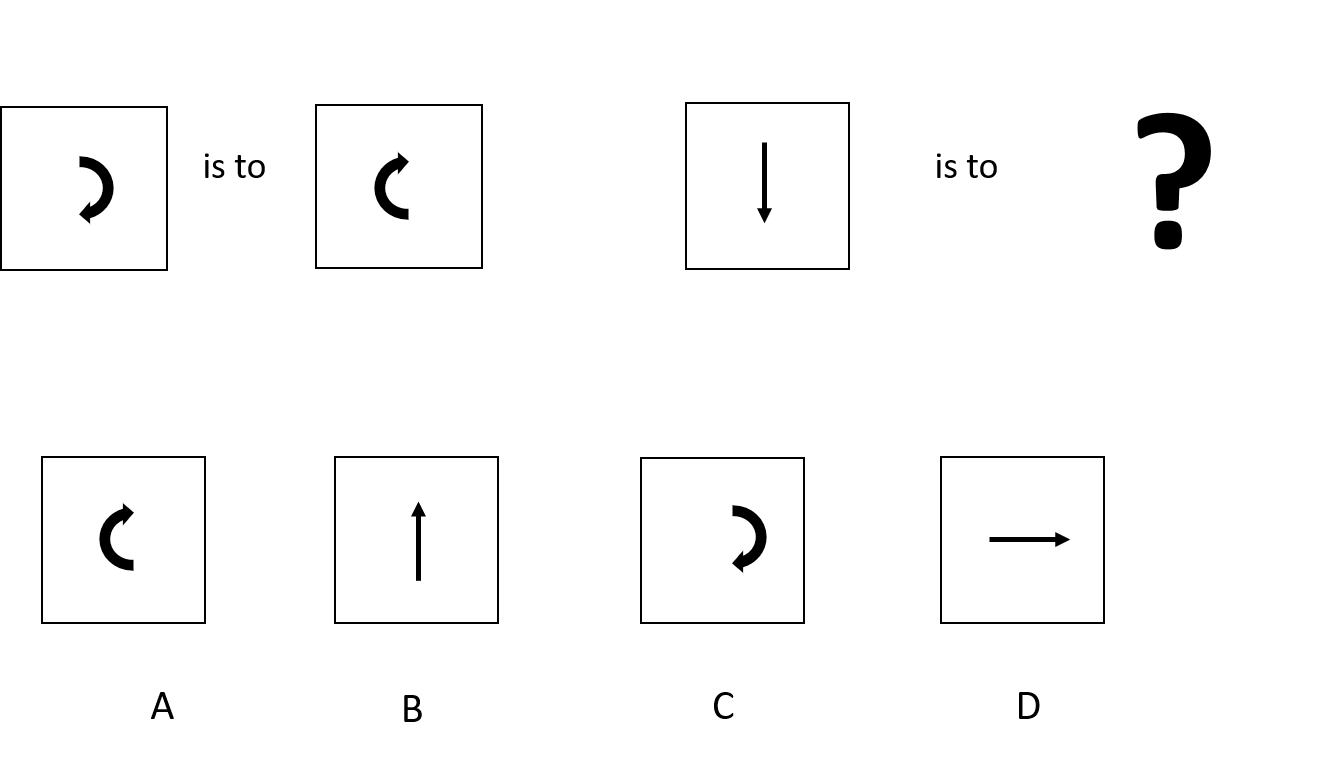
14.Which of the following options best completes the pattern?
Explaination
Correct Answer is E
There are two elements inside of a square in each figure of the sequence.
Rule 1: Triangle moves in corners in clockwise direction of the square in every iteration.
It starts from Top Left > Top Right > Bottom Right > Bottom Left.
So next position will be again back to Top Left
Rule 2: Triangle changes colour in alternate positions from black to white.
So next figure will have black triangle, since the last figure had white triangle
Rule 3: Circle moves in anticlockwise direction as well but it covers midpoint of every side of square along with the corners.
So next figure will circle in bottom right, basis its last position.
So next figure in the sequence which follows all three rules is Option E.
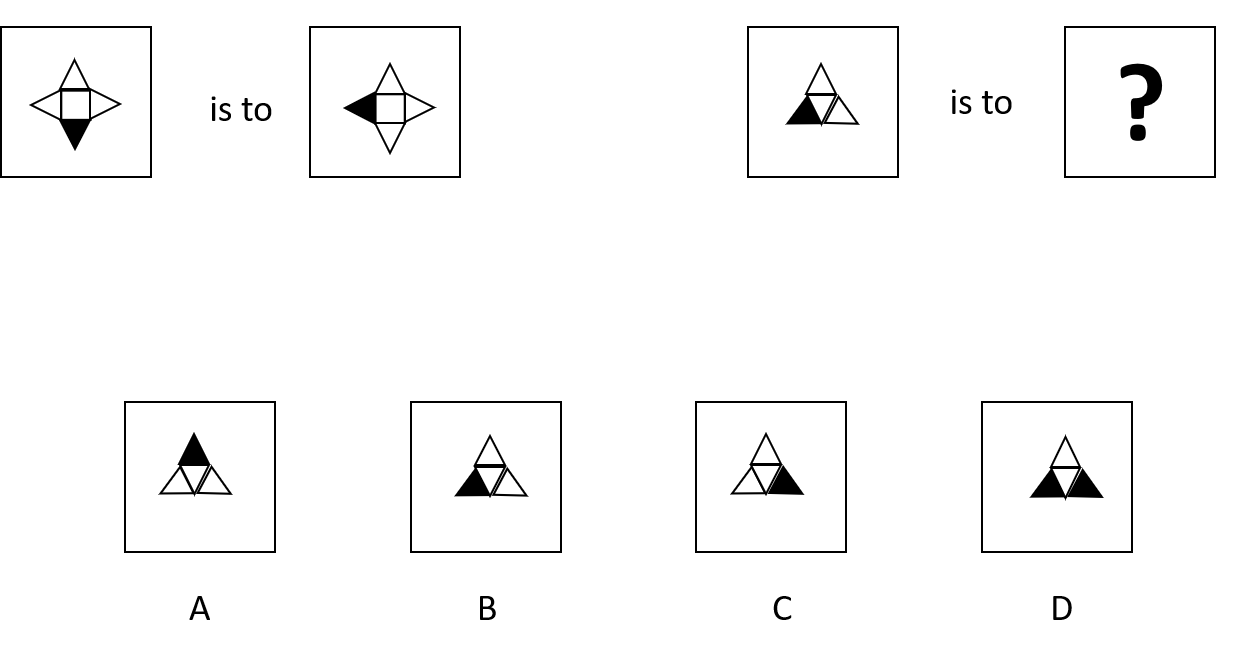
15.Which of the following options best completes the pattern?
Explaination
Answer: Option A
Explanation:
the black triangle is next to the previous black triangle
16.The two figures below share a common feature. One of the figures below does NOT share this same feature. Which figure below does NOT share the common feature?
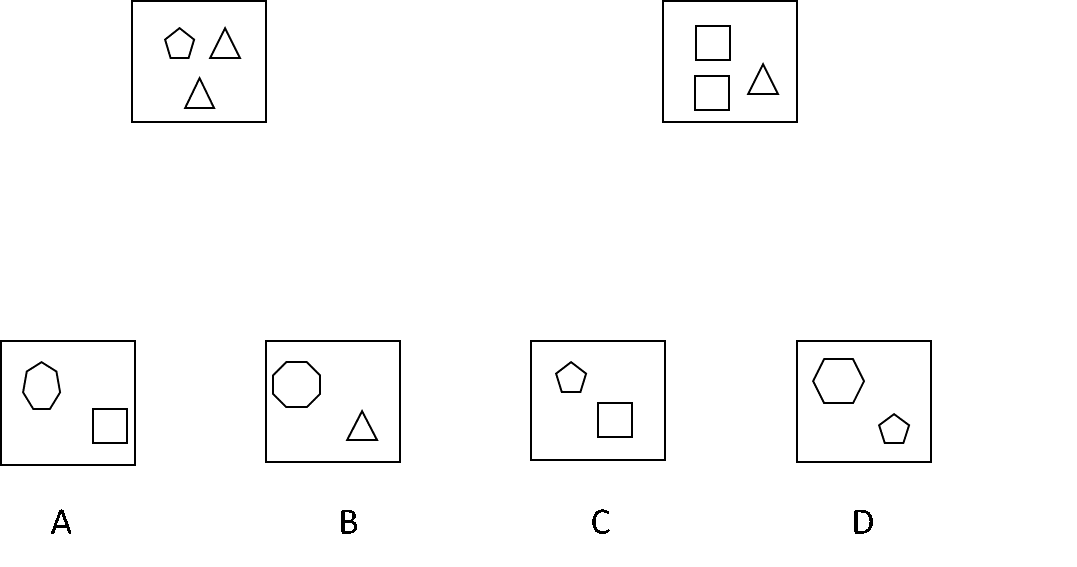
Explaination
If you add up the number of lines in each of the two test images, you’ll get to 11
Answer C has a total of 9 lines.
Ready for test day
Train under the real PI Cognitive conditions
- 6 full-length timed simulations — 50 questions, 12 minutes, exactly like the exam
- 300 questions across all 9 PI types, each with a step-by-step explanation
- Time-management techniques to answer more questions accurately under pressure
How to Prepare for the Predictive Index Cognitive Assessment
The PI Cognitive Assessment gives you 50 questions in 12 minutes — roughly 14 seconds per question — so preparation is less about learning new material and more about building speed and instant question-type recognition.
Most candidates answer only 20–30 of the 50 questions. The average raw score is around 20, while a competitive score (the ~320 scaled mark many employers screen for) means answering about 27 questions correctly under the clock.
Because there is no penalty for wrong answers, your goal is to attempt as many questions as possible without stalling on any single one. Effective preparation focuses on:
- Practicing under a strict timer, not at your own pace
- Recognizing each of the 9 PI question types on sight
- Building mental-math and pattern-recognition speed
- Knowing when to skip and guess rather than lose 30 seconds on one problem
Consistent timed practice is what moves candidates from average to competitive — the difference is rarely ability, and almost always pacing.
Predictive Index Cognitive Assessment FAQ
What is a good score on the Predictive Index cognitive assessment?
A good score depends on the role and employer expectations. Generally, higher scores indicate stronger problem-solving ability and faster learning potential.
How difficult is the Predictive Index test?
The test is not necessarily difficult conceptually, but the strict time limit makes it challenging. Many candidates struggle because they cannot complete all questions within the time available.
Can you prepare for the Predictive Index test?
Yes. Practicing reasoning questions and timed aptitude tests can significantly improve performance.
Disclaimer: AptitudeAce is an independent test preparation platform and is not affiliated with, endorsed by, or sponsored by The Predictive Index, LLC. The Predictive Index and PI Cognitive Assessment are registered trademarks of The Predictive Index, LLC. All practice materials in this course are independently developed and are not official PI Cognitive Assessment content. Individual results may vary based on baseline performance, preparation time, and effort invested.
Full Preparation Course
PI Cognitive Assessment Course
6 full-length mocks · 300 questions
- 6 timed full-length mock exams
- 300 questions with worked solutions
- Realistic 12-minute timed practice