CCAT Abstract & Logical Reasoning – Sequences, Matrices, Syllogisms, and Word Comparisons
Updated: August 2026
The CCAT Abstract & Logical Reasoning section tests how quickly you recognize patterns, identify rules, and apply logical reasoning under time pressure.
The questions are not based on prior knowledge.
They measure how efficiently you process new visual or logical information.
This guide explains:
-
How many abstract reasoning questions appear on the CCAT
-
What types of spatial and logical questions to expect
-
Sample CCAT abstract questions
-
Proven strategies to solve them faster
“The CCAT also tests your Numerical Reasoning and Verbal Reasoning. In this guide, we’ll focus on Abstract & Logical Reasoning— but you can also check out our CCAT Numerical Ability Guide and CCAT Verbal Reasoning Guide for complete preparation.”
To understand how this section fits into the overall exam, review the complete CCAT Guide.
How Many Abstract Questions Are on the CCAT?
The CCAT typically includes around 17–19 abstract and logical reasoning questions, though the exact distribution is not officially published.
These questions are mixed throughout the exam — there is no separate section.
Because they often take longer to analyze, managing time is critical.
What Does CCAT Abstract Reasoning Test?
This section evaluates:
-
Pattern recognition
-
Spatial awareness
-
Logical deduction
-
Attention to detail
It does not require math or vocabulary.
It requires rule detection.
CCAT Abstract & Logical Question Types
CCAT Abstract & Logical Question Types
1️⃣ Shape Sequences (What Comes Next?)
Example : Which of the following boxes should replace the question mark(?) to complete the pattern?

Explaination
Correct Answer: B
The series alternates between ‘×’ and ‘ ÷’ . So the next element in the list is ‘×
Number of Questions ~ 4
You are shown a series of shapes that follow a rule.
Your task: identify the rule and choose the next figure.
Common pattern rules include:
-
Rotation
-
Shading changes
-
Adding or removing elements
-
Alternating shapes
-
Position shifts
Strategy
Look for ONE consistent change per step.
Most sequences are simpler than they appear.
If stuck for more than 20 seconds, move on.
Want more like this under timed pressure? Try the free 5-minute CCAT test →
2️⃣ Odd-One-Out
Example – Which of the following does not belong?

Explaination
Correct Answer: B
Explanation: This is an outlier identification problem. To solve it, study all 5 options and see what they have in common. In this case, each choice has three shapes. What are those shapes? Each one contains a circle, a pentagon, and a square. Except Choice B. Instead of a square, it has two pentagons. Since this is the only one that doubles up on shapes, it’s the one that doesn’t belong.
Number of Questions ~ 4
You are given 4–5 shapes.
Four follow a rule.
One does not.
Your task: identify the shape that breaks the pattern.
Strategy
Compare shapes in pairs.
Look for:
-
Symmetry
-
Number of elements
-
Rotation consistency
-
Shading patterns
Avoid overcomplicating.
The rule is usually straightforward.
Want more like this under timed pressure? Try the free 5-minute CCAT test →
3️⃣ 3×3 Matrices (Grid Patterns)
Example – Which of the following boxes should replace the question mark (?) to complete the pattern
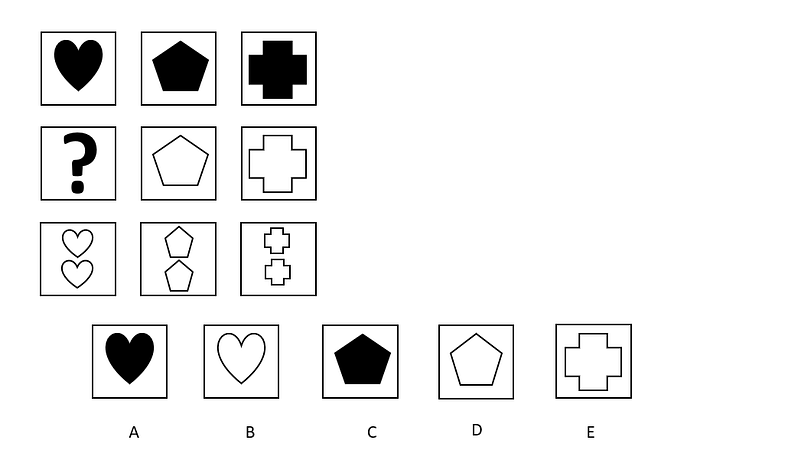
Explaination
The correct answer is B)
Rule 1: Row 1 has grey-colored figures,
Rule 2: Row 3 has the same figures as white but in double quantity
Hence Row 2’s first figure will be a white-coloured figure and a heart(since the first figure of both rows 1 and 3 is a heart).
Only Option B satisfies this criteria
Number of Questions ~ 3
These questions present a 3×3 grid with one missing cell.
You must determine the pattern across rows and columns.
Common rules include:
-
Progressive addition or subtraction
-
Mirroring
-
Shape count changes
-
Combined row/column logic
Strategy
Analyze rows first.
If unclear, analyze columns.
Avoid trying to interpret the entire grid at once.
Want more like this under timed pressure? Try the free 5-minute CCAT test →
4️⃣ Word Comparison (Attention to Detail)
Example – How many of the five items in the left-hand column are exactly the same as the corresponding entry in the right-hand column?
Nucor Steel Co. — — — — — — — — — — — Nucor Steel Comp.
Starks Industrial, Inc. — — — — — — — Starks Industrials, Inc.
Hennery & Davidson — — — — — — — Hennery & Davidsen
Dalliers, Cleeve and Sons — — — — — Dalliers, Cleve and Sons
Titan Chemicals Co. — — — — — — Titan Chemicals Co.
A. 1
B. 2
C. 3
D. 4
E. 5
Explaination
The correct answer is (A)
The completely identical items: Titan Chemicals Co.
mistakes are marked in bold :
Nucor Steel Co. — — — — — — Nucor Steel Comp.
Starks Industrial, Inc. — — — — -Starks Industrials, Inc.
Hennery & Davidson — — — — — Hennery & Davidsen
Dalliers, Cleeve and Sons — -Dalliers, Cleve and Sons
Titan Chemicals Co. — — — — — — Titan Chemicals Co.
Number of Questions ~ 3
Two columns of words are shown.
Your task: count how many pairs are spelled exactly the same.
These questions test concentration under time pressure.
Strategy
-
Compare letter-by-letter
-
Do not skim
-
Avoid rereading entire rows twice
Careless mistakes are common here.
Want more like this under timed pressure? Try the free 5-minute CCAT test →
5️⃣ Syllogisms (Logical Statements)
Example – Assume the first two statements are true. Is the final statement: 1) True, 2) False, or 3) Uncertain based on the information provided?
Geoffrey is older than Harry.
Harry is older than Gavin.
Gavin is older than Geoffrey
A)TRUE
B)FALSE
C)Uncertain
Explaination
Correct Answer: B
Let’s employ mathematical symbols to aid in our comprehension. “Greater than” (>) signifies “older than,”
(1) Geoffrey is older than Harry: Geoffrey > Harry.
(2) Harry is older than Gavin: Harry > Gavin
Hence, we deduce that — Geoffrey > Harry > Gavin
Hence, the Third statement says which says Gavin is older than Geoffrey is False
Hence the correct answer is B) — False
Number of Questions ~ 3
You are given statements (premises) and must determine whether a conclusion logically follows.
Possible answers:
-
True
-
False
-
Cannot be determined
Strategy
-
Do not assume outside information
-
If it is not 100% provable, choose “Cannot be determined”
-
Consider drawing quick mental Venn diagrams
Want more like this under timed pressure? Try the free 5-minute CCAT test →
Is the CCAT Abstract Section Hard?
Many candidates find abstract reasoning difficult because:
-
It is unfamiliar
-
It cannot be memorized
-
It requires fast pattern recognition
However, most rules are simple once identified.
The difficulty lies in speed and avoiding overanalysis.
Can You Prepare for Abstract Reasoning?
Yes.
Strong performers:
-
Practice identifying common pattern rules
-
Train under timed conditions
-
Avoid perfectionism
-
Learn to skip quickly when stuck
Timing Strategy for Abstract Questions
Abstract questions can consume time quickly.
Best approach:
-
Solve obvious patterns immediately
-
Skip complex matrices early
-
Return if time allows
-
Never leave blanks (no negative marking)
One difficult matrix question is not worth 30–40 seconds.
Common Abstract Mistakes
-
Overcomplicating simple rules
-
Ignoring column logic in matrices
-
Assuming external logic in syllogisms
-
Rushing through word comparison
Pattern recognition improves with repetition.
7-Day Abstract Practice Plan
Day 1–2: Shape sequences
Day 3: Odd-one-out drills
Day 4: Matrix practice
Day 5: Syllogism practice
Day 6: Mixed timed set
Day 7: Full-length simulation
Training under time pressure improves performance more than passive review.
How Abstract Reasoning Impacts Your Score
Abstract & logical reasoning typically account for roughly one-quarter to one-third of the CCAT.
Improving just 3–5 abstract questions can significantly raise your overall percentile.
The key is recognizing patterns quickly — not solving every puzzle perfectly.
Check what score you need: CCAT Score Guide → · Which companies use the CCAT →
Disclaimer: AptitudeAce is an independent test preparation platform and is not affiliated with, endorsed by, or connected to Criteria Corp, Talogy, or any employer mentioned on this page. CCAT is a registered trademark of Criteria Corp. All practice materials are independently developed based on publicly available information about the test format. Individual results may vary based on baseline performance, preparation time, and effort invested.
Full Preparation Course
CCAT Practice Test Course
6 full-length mocks · 300 questions
- 6 timed full-length mock exams
- 300 questions with worked solutions
- Section analysis email after every test
"Question types were similar to the ones I practiced, which helped me score 31/50."
— roman t, verified purchaser
Practice turns Potential into Performance.
support@aptitudeace.com