Crack the Matrigma Test Free – Guide, Sample Questions, and Tips
Updated: August 2026
What is the Matrigma Test?
The Matrigma test assesses general cognitive abilities through a series of non-verbal questions. Unlike traditional exams that may test specific skills or knowledge, the Matrigma test measures how well you can identify patterns, solve abstract problems, and process complex information. These abilities are key indicators of a person’s potential for success in various professional roles.
The Format of the Matrigma Test
The Matrigma test consists of multiple-choice questions that focus on pattern recognition and logical reasoning. It is an Abstract Reasoning test with a single type of question presented in 3×3 matrices in which you’re asked to find the missing element. The test is non-verbal, meaning that no language skills are required, making it universally applicable.
There are two versions of the test: the Classic Matrigma test and the Adaptive Matrigma test. Both versions are designed to gauge an individual’s reasoning skills, but the adaptive format adjusts the difficulty of questions in real time based on the test taker’s performance.
- Classic Matrigma: The questions become progressively more challenging as you advance through the test.
- Adaptive Matrigma: The difficulty level adjusts based on your responses. Correct answers lead to harder questions, while incorrect answers will result in easier ones.
Key Features of the Matrigma Test Format:
- Non-Verbal Reasoning: All questions are visual, with no verbal or numerical reasoning involved.
- Multiple Choice: Each question presents a pattern or sequence, and the test-taker must choose the correct answer from several options.
- Time-Limited: The test is typically timed, with a standard version lasting around 40 minutes. The adaptive version may adjust the time slightly based on difficulty.
- Adaptive Version: The adaptive Matrigma test tailors its difficulty according to the test-taker’s performance. If you answer a question correctly, the next one will be more challenging. If you answer incorrectly, the following question will be slightly easier.
Classic vs Adaptive Matrigma: What's the Difference and Which Will You Face?
Most candidates don’t know which version they’ll be taking until they sit the test — and the two versions feel very different under exam conditions.
Classic Matrigma The classic version presents questions in a fixed order of increasing difficulty. You have a set time limit (typically 40 minutes for the full test) and work through questions sequentially. The difficulty curve is predictable — earlier questions are easier, later ones harder. This format rewards candidates who can maintain focus and accuracy as pressure builds.
Adaptive Matrigma The adaptive version adjusts in real time based on your answers. Answer correctly and the next question gets harder. Answer incorrectly and it gets slightly easier. This means:
- You cannot predict the difficulty of the next question
- Two candidates sitting the same test may see completely different questions
- Your score reflects not just how many you get right, but the difficulty level of questions you answered correctly
- There is no benefit to rushing — accuracy matters more than speed in the adaptive format
Which version do employers use?
Both versions are in active use. Assessio (the Swedish test publisher behind Matrigma) offers both to employers. In practice, larger organisations and consulting firms tend to use the adaptive version for its precision, while smaller employers may use the classic version.
How to prepare for both:
The underlying skill being tested is identical — abstract pattern recognition using 3×3 matrices. The strategy differs slightly:
- For Classic: build speed on easier questions early to save time for harder ones later
- For Adaptive: prioritise accuracy over speed — rushing and getting questions wrong will drag you into easier (lower-scoring) questions
Advantages of the Adaptive Matrigma Test:
- Precision: The adaptive format gives a more accurate measurement of your cognitive abilities.
- Efficiency: With questions adapting to your level, the test avoids wasting time on questions that are too easy or too difficult.
- Engagement: The real-time adjustment keeps the test challenging, making it more engaging for candidates.
Sample Matrigma Test Questions
Example – Which of the following boxes should replace the question mark (?) to complete the pattern
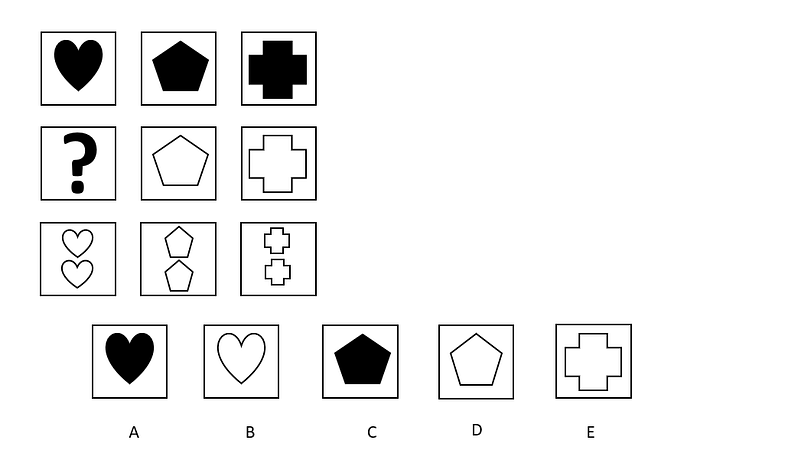
Explaination
The correct answer is B)
Rule 1: Row 1 has grey-colored figures,
Rule 2: Row 3 has the same figures as white but in double quantity
Hence Row 2’s first figure will be a white-coloured figure and a heart(since the first figure of both rows 1 and 3 is a heart).
Only Option B satisfies this criteria
Example – Which of the following boxes should replace the question mark (?) to complete the pattern
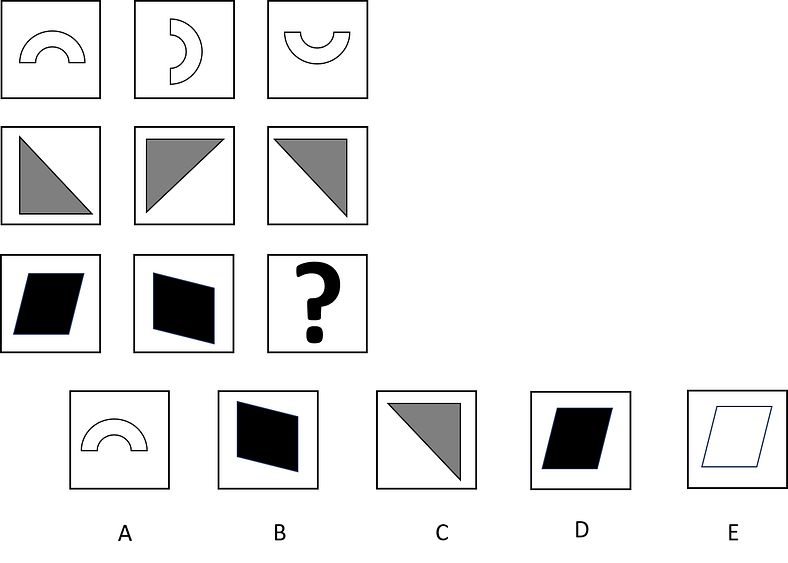
Explaination
The correct answer is D. Within each row, the element rotates 90 degrees clockwise with each step to the right.
Full Length Matrigma Test Practice
For additional practice questions and answers tailored to the Matrigma Test, we recommend exploring our Full-length 3 Matrigma Practice Tests.. If you seek a test simulation closely mirroring the real exam experience, consider visiting our course. Engaging in full-length tests aids in acclimating to time constraints, ultimately improving your score in Matrigma.
These types of questions are designed to test your ability to recognize patterns, think logically, and make quick decisions under time pressure. Practicing these types of problems beforehand can help you become familiar with the format and improve your performance.
Matrigma Test Results
Upon completing the Matrigma test, you will receive a score that reflects your general cognitive ability. Your Matrigma test results are compared to a norm group, which allows employers to understand how your performance ranks against other candidates.
Understanding Your Results:
Your Matrigma score is norm-referenced — meaning it reflects how you perform relative to other candidates, not against a fixed pass mark. Assessio (the test publisher) reports scores on a percentile scale, allowing employers to compare candidates directly.
- High score (top 25%): Indicates strong abstract reasoning and pattern recognition ability. Typically expected for analytical, technical, and leadership roles.
- Mid-range score (25th–75th percentile): Reflects solid cognitive ability suitable for most professional roles.
- Lower score (bottom 25%): May indicate difficulty with abstract reasoning under timed conditions. Practicing with realistic test simulations can improve familiarity with the format.
There is no universal pass mark — employers set their own benchmarks depending on the role and candidate pool.
How to Prepare for the Matrigma Test
While the Matrigma test is designed to measure innate cognitive ability, practicing similar questions can help you become more comfortable with the test format. Familiarizing yourself with pattern recognition, logical reasoning, and visual problem-solving will improve your confidence and ability to perform well under time constraints.
- Practice Tests: Completing practice tests that mimic the format of the Matrigma test can help you get accustomed to the question types and the timed nature of the exam. Explore our Matrigma Practice Tests for full-length exam-style practice.
- Stay Calm: Since the test is timed, it’s important to work quickly but also carefully. Stress can hinder performance, so practice relaxation techniques that will keep you calm and focused during the test.
The Matrigma test is a valuable tool used by many companies to assess candidates’ cognitive potential in an unbiased and non-verbal format. Whether you’re taking the classic or adaptive Matrigma test, understanding the format and practicing similar questions can significantly boost your confidence and performance. Remember, the key to success is familiarization with the question types and staying calm under pressure.
For those looking to prepare, consider taking a Matrigma test free practice assessment to gauge your abilities and improve your pattern recognition skills before the actual test.
Matrigma Test Tips: How to Improve Your Score
1. Learn the common pattern rules first Every Matrigma question tests one or more of these rules: rotation, reflection, size progression, colour/shading change, addition or removal of elements, and quantity progression. Before your test date, make sure you can recognise each of these instantly. Most questions combine two rules simultaneously — spotting the first rule quickly narrows your answer choices significantly.
2. Use elimination aggressively Never spend time confirming the right answer when you can eliminate wrong ones. With 8 answer options, ruling out 5–6 incorrect answers is faster than proving one correct answer from scratch.
3. Scan rows and columns separately When you look at a 3×3 matrix, check each row left to right first, then each column top to bottom. Most patterns are consistent either across rows or down columns — rarely both. Identifying the axis of the pattern cuts your analysis time in half.
4. Don’t let hard questions steal your time In the classic version especially, a single difficult question can consume time you need for three easier ones. If you’re stuck after 30 seconds, mark your best guess and move on. Come back if time allows.
5. Practice under real timing conditions The Matrigma test is time-pressured. Practicing without a timer gives you false confidence. Always simulate the full 40-minute window with no breaks, no notes, and no distractions — exactly as you’ll face on test day.
6. For the adaptive version — prioritise accuracy In the adaptive format, getting questions right at higher difficulty levels earns a better score than answering more questions at lower difficulty. Slow down slightly on harder questions rather than rushing and falling back to easier ones.
Frequently Asked Questions: Matrigma Test
What is the Matrigma test? The Matrigma test is an abstract reasoning assessment developed by Assessio, a Swedish psychometric test publisher. It measures general cognitive ability through 3×3 matrix questions requiring pattern recognition and logical reasoning. It is widely used by employers in Scandinavia, the Netherlands, and internationally.
What is the difference between Classic and Adaptive Matrigma? The Classic Matrigma presents questions in a fixed order of increasing difficulty. The Adaptive Matrigma adjusts question difficulty in real time based on your answers — correct answers lead to harder questions, incorrect answers lead to easier ones. Both versions test the same underlying skill but require slightly different strategies.
How long is the Matrigma test? The standard Classic Matrigma test lasts 40 minutes. The Adaptive version may vary slightly depending on the employer’s configuration.
Is there a free Matrigma practice test? There is no official free practice test published by Assessio. However, practicing with realistic matrix reasoning questions — such as those in our Matrigma practice course — is the most effective preparation method available.
What is a good Matrigma score? There is no universal pass mark. Scores are norm-referenced, meaning your result is compared to other candidates. A score in the top 25% is generally considered strong for analytical and technical roles. Employers set their own benchmarks depending on the role.
Which companies use the Matrigma test? The Matrigma test is commonly used by employers in Sweden, Norway, the Netherlands, and other European markets. It is particularly common in consulting, finance, engineering, and graduate recruitment.
Can I retake the Matrigma test? This depends on the employer. Most employers allow only one attempt per application. Some may allow a retake after a waiting period if you reapply.
Does the Matrigma test have questions and answers available? Assessio does not publish official answer keys. Our practice course includes full-length Matrigma-style tests with detailed explanations for every question.
Disclaimer: AptitudeAce is an independent test preparation platform and is not affiliated with, endorsed by, or sponsored by Assessio. Matrigma is a trademark of Assessio. All practice materials in this course are independently developed and are not official Matrigma content. Individual results may vary based on baseline performance, preparation time, and effort invested.
Full Preparation Course
Matrigma Practice Test Course
3 full-length mocks · 105 questions
- 3 timed full-length mock exams
- 105 matrix reasoning questions
- Detailed step-by-step explanations
"Passed my Matrigma on the first attempt. The pattern explanations made everything click."
— [Tom Neuman]