The Ultimate Guide to Raven’s Advanced Progressive Matrices (APM): History, Hiring Use, Pain Points & Preparation
Updated: Feb 2026 | Used by 10,000+ Learners Globally
If you’ve been asked to take the Raven’s Advanced Progressive Matrices (APM) test, you’re probably wondering:
-
What exactly is this test measuring?
-
Why are companies using it in hiring?
-
Why do some people find it extremely difficult?
-
And how should you prepare without wasting time?
Raven’s APM is not a typical IQ test. It contains no vocabulary, no math problems, and no reading passages. Instead, it measures your ability to detect patterns, think abstractly, and solve problems you’ve never seen before.
In this guide, you’ll learn everything a first-time test taker needs to know — including real challenges candidates face and how to avoid common mistakes.
What Is Raven’s Advanced Progressive Matrices?
Raven’s Advanced Progressive Matrices is a nonverbal reasoning test originally developed by John C. Raven in the 1930s.
His goal was simple: create a test of intelligence that did not depend on language, education level, or cultural background.
Instead of questions with words, the test presents visual patterns arranged in a matrix (usually 3×3), with one piece missing. Your job is to determine which option correctly completes the pattern.
There are no tricks. No hidden vocabulary. No formulas. Just pure reasoning.
That’s why Raven’s APM is often described as one of the best measures of fluid intelligence — your raw ability to think logically in new situations.
Why Is Raven’s APM Used in Hiring?
Many candidates are surprised to see Raven-style tests during job applications.
But from an employer’s perspective, the appeal is obvious.
Unlike resumes, interviews, or academic grades, matrix reasoning tests measure:
-
Problem-solving speed
-
Pattern recognition ability
-
Logical consistency
-
Cognitive flexibility
Large organizations don’t usually say “We use Raven’s APM” directly. Instead, they license cognitive assessments through vendors like:
-
Pearson (TalentLens Raven Adaptive)
-
Hogan Assessments (APM-III versions)
These assessments are commonly used in:
-
Consulting recruitment
-
Finance graduate programs
-
Engineering roles
-
Government screening
-
High-volume corporate hiring
If you’re applying to competitive roles, especially in consulting, banking, analytics, or tech, there’s a high chance you’ll encounter a Raven-style abstract reasoning test.
Why Do People Find Raven’s APM So Difficult?
At first glance, the questions look simple. Just shapes and patterns.
But here’s where candidates struggle.
1. The Questions Get Progressively Hard
The test is structured so that each question builds in complexity. Early items may involve a single rule (like rotation). Later questions combine multiple rules simultaneously — rotation + shape addition + shading change.
Under time pressure, that complexity compounds.
2. Time Pressure Changes Everything
In research settings, Raven’s APM is often untimed.
In hiring environments, it usually isn’t.
Candidates commonly report:
-
Getting stuck on one question
-
Rushing through final items
-
Losing accuracy under pressure
The difficulty is not always the logic itself — it’s managing speed and accuracy together.
3. Practice Tests Can Be Misleading
Many free online Raven tests are not official and reuse old item banks.
This creates a dangerous illusion:
You score high during practice, then perform worse in the real assessment.
That’s because familiarity improves recognition — but doesn’t always improve reasoning skill.
4. It Tests Thinking, Not Knowledge
You cannot memorize formulas for this test.
You can’t “study content.”
You must train your brain to:
-
Identify rule patterns quickly
-
Eliminate incorrect options efficiently
-
Avoid overthinking
That’s uncomfortable for many test-takers.
What Exactly Does Raven’s APM Measure?
Raven’s Advanced Progressive Matrices measures fluid intelligence (Gf).
Fluid intelligence is your ability to:
-
Solve novel problems
-
Detect abstract relationships
-
Think logically without prior knowledge
It does NOT measure:
-
Vocabulary
-
Academic knowledge
-
Memory recall
-
Emotional intelligence
Because of this narrow focus, Raven’s APM is powerful — but not a full picture of intelligence.
How the Test Is Structured
The APM consists of 48 questions divided into two sets:
-
Set I (12 questions): Introductory level
-
Set II (36 questions): Increasingly difficult core assessment
Each question contains:
-
A visual 3×3 matrix
-
One missing cell
-
Multiple answer choices
There are no words. No numbers. Just abstract shapes.
Sample Raven's Matrices Questions
Example – Which of the following boxes should replace the question mark (?) to complete the pattern
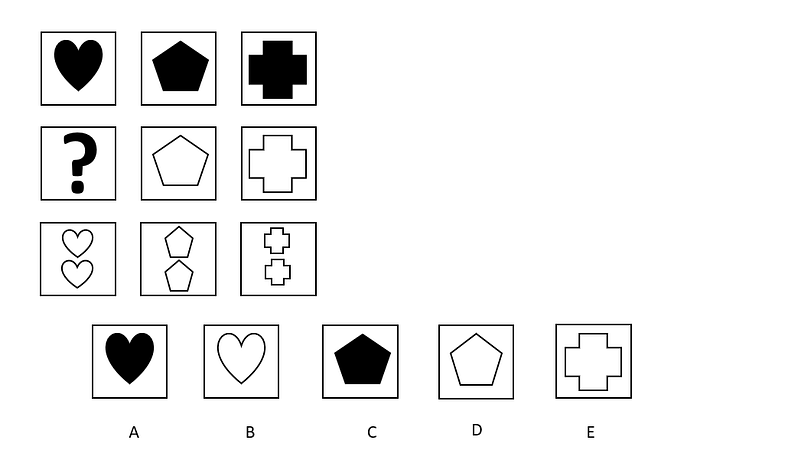
Explaination
The correct answer is B)
Rule 1: Row 1 has grey-colored figures,
Rule 2: Row 3 has the same figures as white but in double quantity
Hence Row 2’s first figure will be a white-coloured figure and a heart(since the first figure of both rows 1 and 3 is a heart).
Only Option B satisfies this criteria
Example – Which of the following boxes should replace the question mark (?) to complete the pattern

Explaination
The correct answer is D. Within each row, the element rotates 90 degrees clockwise with each step to the right.
Real Pain Points You Should Be Aware Of
If you’re preparing for Raven’s APM, here’s what experienced candidates wish they knew beforehand:
Don’t Try to “Force” a Pattern
Sometimes candidates assume every pattern must follow arithmetic logic. Many items instead rely on visual progression or positional relationships.
If a rule feels forced, it probably is.
Use Elimination Aggressively
The fastest way to solve matrix problems is not to find the correct answer.
It’s to eliminate clearly wrong ones.
Most answer options violate at least one rule.
Skip When Stuck
Spending 3 minutes on one item can cost you multiple easier questions later.
Train yourself to mark and return.
Test on the Right Device
Matrix clarity matters.
Take the test on:
-
A large screen
-
Good lighting
-
No distractions
Mobile devices significantly increase error rates.
Alva Logic Test Preparation Course
Our dedicated Alva Logic Prep course includes:
-
Realistic Alva-style practice questions
-
Timed mock tests aligned with the official format
-
Step-by-step explanations
-
Structured practice to improve confidence and consistency
Pros and Cons of Raven’s Advanced Progressive Matrices
Advantages
-
Language-free and culture-reduced
-
Strong scientific backing
-
Excellent for screening high cognitive ability
-
Difficult to “fake”
Limitations
-
Measures only abstract reasoning
-
No diagnostic subscores
-
Practice effects exist
-
Can disadvantage slower but accurate thinkers in timed settings
How to Prepare Effectively
You don’t “study” Raven’s APM.
You train for it.
Focus on:
-
Recognizing common pattern types
-
Improving elimination speed
-
Practicing under timed conditions
-
Avoiding overexposure to identical tests
Consistency beats cramming.
Final Thoughts
Raven’s Advanced Progressive Matrices is one of the most respected nonverbal intelligence tests ever developed.
It is simple in appearance — but cognitively demanding.
If you approach it casually, you may underperform.
If you prepare strategically, manage your time, and understand the structure, you dramatically increase your chances of success.
For job applicants, it’s not just another test.
It’s often the gatekeeper.
Official Sources
Raven’s Advanced Progressive Matrices (APM) is described by Pearson Assessments as a non-verbal tool that measures high-level observation skills, clear thinking ability, and intellectual capacity.
🔗 https://www.pearsonassessments.com/en-us/Store/Professional-Assessments/Cognition-%26-Neuro/Raven%E2%80%99s-Advanced-Progressive-Matrices/p/100000414
Alva Labs Test Practice
⭐⭐⭐⭐⭐ 5.0 | Real Alva Labs style questions
Lifetime Access | One-Time Purchase
What’s included
- 4 Full Length Alva Labs Logic Style Mock Tests
- Real exam-style difficulty & timing
- Pattern rules & solving strategies