CCAT Score Guide (2026): What Is a Good CCAT Score, Percentiles & Passing Benchmarks
Updated: August 2026
What is a good CCAT score in 2026?
A good CCAT score depends on the role you’re applying for, but in most cases, scoring 31 or higher puts you ahead of the majority of candidates. This CCAT score guide explains how CCAT scores work, how raw scores convert into percentiles, what employers consider a passing score, and what your result actually means for your job application.
Whether you scored 24, 31, or 36+, this page will help you benchmark your performance accurately and decide how to improve.
For a full breakdown of question types and preparation strategy, refer to our complete CCAT Guide.
Why This CCAT Score Guide Is Reliable
This guide is based on:
Analysis of thousands of CCAT practice attempts
Real employer cutoff trends across industries
Timed mock tests designed to mirror actual CCAT difficulty
It reflects real-world hiring expectations, not theoretical scoring.
How Is the CCAT Scored?
The Criteria Cognitive Aptitude Test (CCAT) uses two scoring measures.
1. Raw Score (0–50)
Number of correct answers out of 50
No negative marking
Skipped questions do not reduce your score
2. Percentile Score
Shows how you performed compared to other candidates
Example: 80th percentile means you scored higher than 80% of test takers
👉 Employers usually care more about percentile than raw score.
If you’re unsure how the test is structured, review the CCAT Exam Format breakdown.
CCAT Score Percentile Table (2026 Updated)
| Correct Answers | Percentile |
|---|---|
| 8 | 3% |
| 12 | 8% |
| 16 | 17.5% |
| 20 | 32% |
| 24 | 50% |
| 28 | 68% |
| 31 | 80% |
| 36 | 92% |
| 40 | 97% |
| 44 | 99% |
| 50 | 99.9% |
These cutoff points will help you interpret your performance using this CCAT score guide.
👉 Want to know where you stand under real test pressure?
What Is a Good CCAT Score?
A “good” CCAT score depends on job complexity, but general benchmarks are:
Average score: ~24 (50th percentile)
Good score: 31 (Top 20%)
Very good score: 33–36
Excellent score: 36+
Elite score: 40+
🎯 For most professional, analytical, and corporate roles, 31–35 is a strong target range.
Is 31 a Good CCAT Score?
Yes. A score of 31 places you around the 80th percentile, meaning you performed better than 4 out of 5 candidates. This is considered competitive for most roles.
Is 36 a Good CCAT Score?
A score of 36+ is excellent and places you in the top 8–10% of test takers. This range is often competitive for technical, analytical, and leadership roles.
CCAT Passing Scores by Job Role
the table below—based on an official CCAT sample score report—can give you a clear estimate of the score you’ll likely need to pass for your target role.
This CCAT score guide includes common employer benchmarks:
| Job Role | Typical Passing Score |
|---|---|
| Administrative | 20–32 |
| Customer Service | 18–32 |
| Sales Representative | 21–35 |
| Bookkeeper | 20–35 |
| Recruitment | 21–35 |
| Operations Manager | 22–40 |
| Project Manager | 22–37 |
| Programmer | 23–40 |
| Network Admin | 23–37 |
| Finance/Accounting | 24–39 |
| Analyst Roles | 26–42 |
| Product Manager | 26–41 |
| Senior Manager/VP | 29–42 |
| Lawyer | 29–42 |
⚠️ These are benchmarks, not guarantees. Employers may adjust cutoffs depending on applicant volume and role seniority.
Find out what score your specific employer expects → see the full list of companies using the CCAT
Understanding the CCAT Score Distribution
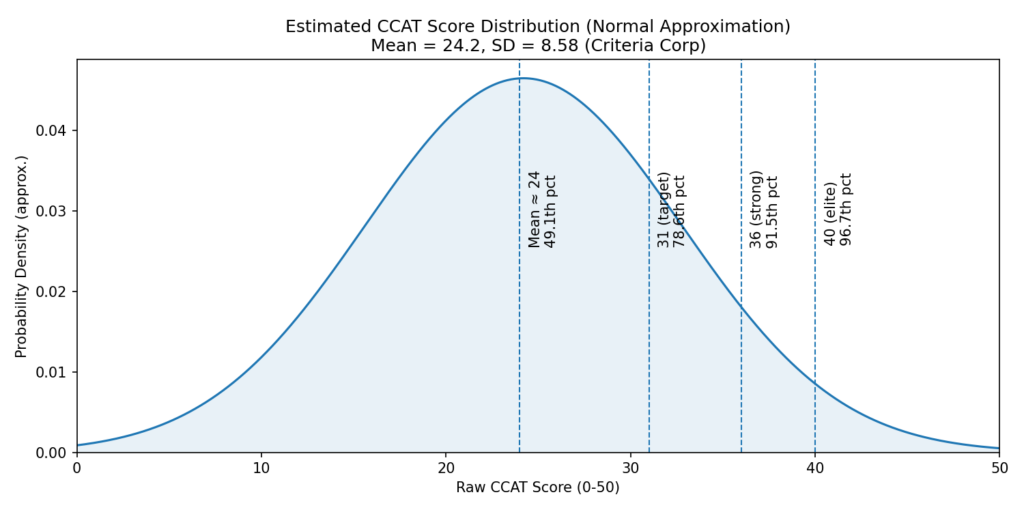
The CCAT score distribution follows a near-normal bell curve. The average score is approximately 24, which corresponds to the 50th percentile.
A score of 31 moves you close to the 80th percentile, while 36 places you above 90% of test takers.
Because the distribution is non-linear, small improvements in raw score (5–7 additional correct answers) can produce significant percentile gains.
This means improving by just 6–8 correct answers can move you from average to top-tier percentiles
Struggling with specific question types? See our guides for Numerical, Verbal, and Abstract reasoning.
What Does Your CCAT Score Measure?
Your CCAT score reflects combined performance across:
Verbal Reasoning – analogies, vocabulary, sentence logic
Math & Logical Reasoning – word problems, equations, number patterns
Abstract / Spatial Reasoning – shape sequences and transformations
Employers use CCAT scores to assess learning speed, problem-solving ability, and cognitive potential — not prior knowledge.
What Score Should You Aim For?
Use this CCAT score guide to decide your target:
| Goal | Recommended Score |
|---|---|
| Minimum standard | 24–28 |
| Competitive | 30–35 |
| Analytical/technical | 33–38 |
| High difficulty roles | 36+ |
| Leadership roles | 40+ |
How Hard Is It to Score 36+ in CCAT?
Scoring above 36 is statistically difficult. Only 8–10% of candidates reach this level.
It requires:
Fast pattern recognition
Strong mental math
Smart guessing and elimination
Excellent time management
How to Improve Your CCAT Score
This CCAT score guide includes the most effective improvement strategies:
1. Prioritise Accuracy in the 25–35 Range
This range gives the biggest boost in percentile.
2. Don’t Spend More Than 30 Seconds on Any Question
Guess and move on if needed.
3. Know Your Weak Areas
Fixing one weak category can add 5–7 points to your score.
4. Practice Under Real Test Conditions
Timed practice is essential.
CCAT Score Interpretation Guide
Use this CCAT score guide to understand your result:
| Score | Interpretation |
|---|---|
| 0–20 | Below average |
| 20–28 | Average range |
| 28–33 | Above average |
| 33–38 | Excellent |
| 38–42 | Top performer |
| 42–50 | Extremely rare |
How Employers Use CCAT Scores
Recruiters typically:
Compare your percentile to internal benchmarks
Check section-wise strengths
Combine CCAT results with interviews and personality assessments
A strong CCAT score significantly improves shortlisting chances.
Final Takeaway: Use Your CCAT Score Strategically
Understanding CCAT scoring helps you:
Set realistic targets
Focus preparation where it matters most
Avoid wasting time on low-impact effort
FAQ
Question: What is a good CCAT score?
Answer: A score of 31 or higher is generally considered competitive, placing you around the 80th percentile. Scores of 36+ are typically above the 90th percentile and considered strong for analytical roles.
Question: What percentile is a 31 on the CCAT?
Answer: A raw score of 31 corresponds to approximately the 80th percentile based on published normative data.
Question: What percentile is a 36 on the CCAT?
Answer: A raw score of 36 is typically around the 91st–92nd percentile.
Or take the free 5-minute test to benchmark where you stand first.
Other cognitive tests you may face
Disclaimer: AptitudeAce is an independent test preparation platform and is not affiliated with, endorsed by, or sponsored by Criteria Corp or Talogy. The Criteria Cognitive Aptitude Test (CCAT) is a registered trademark of Criteria Corp. Score benchmarks and percentile data referenced on this page are based on publicly available normative information. This page is intended for preparation guidance only.
Full Preparation Course
CCAT Practice Test Course
6 full-length mocks · 300 questions
- 6 timed full-length mock exams
- 300 questions with worked solutions
- Section analysis email after every test
"Question types were similar to the ones I practiced, which helped me score 31/50."
— roman t, verified purchaser
Practice turns Potential into Performance.
support@aptitudeace.com